The role identification for both ends of a Type-C interface is actually detected and configured through two CC wires within the Type-C connector. As shown in the diagram below:
Type-C Connection Diagram
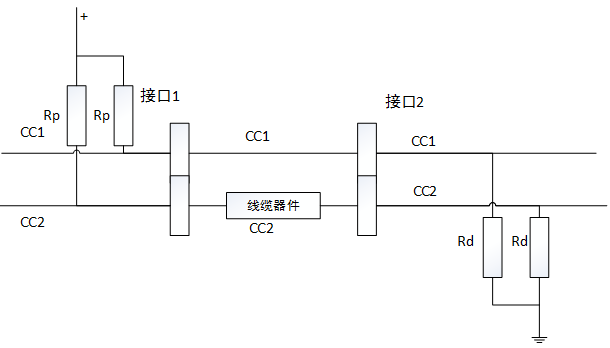
Here, the cable component refers to cables equipped with an eMark chip that utilize Vconn power supply. Once one CC confirms the direction, the other CC on the Source side switches to Vconn to power the eMark. Cables with an eMark chip can communicate with the device via CC, providing feedback on the cable’s temperature and current-carrying capacity. This significantly enhances safety for high-power charging.
Interface 1 acts as the power provider, with pull-up resistors (Rp) connected to its two CC lines;
Interface 2 acts as the power consumer, with pull-down resistors (Rd) connected to its two CC lines.
When the two interfaces connect:
- Interface 1 detects the other’s Rd pull-down, confirming a successful connection and identifying the other as the power consumer;
When Interface 2 detects the other’s Rp pull-up, it confirms a successful connection and identifies the other as the power-supplying role. If two interfaces of the same role (either power-supplying or power-consuming) connect, neither can detect the desired Rd pull-down or Rp pull-up, rendering both inoperable.
For Dual Role (DRP) interfaces, the two CC lines continuously toggle between the Rp pull-up state and the Rd pull-down state.
When connecting to a non-Dual Role device:
- If the other party is in the Rp pull-up state, this interface will remain in the Rd pull-down state, functioning as a power consumer.
If the other device is in Rd-down state, this interface will remain in Rp-up state, acting as the power consumer. When connected to a dual-role device, both interfaces randomly settle into either Rp-up or Rd-down state. A connection is established when one interface is in Rp-up state and the other is in Rd-down state. The party in the Rp pull-up state becomes the power provider, while the party in the Rd pull-down state becomes the power consumer.
Regardless of whether it’s the power supply role or the communication function role, the initial role determined at connection is not permanently fixed. It can be switched via the power supply protocol, with specific details to be covered later. A product designed as a pure power supplier with a communication function of UFP must act as a power supplier during connection. Consequently, its communication function is DFP at connection. After connection, this product must switch its communication function to UFP via the power supply protocol.
- High-Performance Waterproof Solar Connectors
- Durable IP68 Waterproof Solar Connectors for Outdoor Use
- High-Quality Tinned Copper Material for Durability
- High-Quality Tinned Copper Material for Long Service Life
- Y Branch Parallel Solar Connector for Enhanced Power
- 10AWG Tinned Copper Solar Battery Cables
- NEMA 5-15P to Powercon Extension Cable Overview
- Dual Port USB 3.0 Adapter for Optimal Speed
- 4-Pin XLR Connector: Reliable Audio Transmission
- 4mm Banana to 2mm Pin Connector: Your Audio Solution
- 12GB/s Mini SAS to U.2 NVMe Cable for Fast Data Transfer
- CAB-STK-E Stacking Cable: 40Gbps Performance
- High-Performance CAB-STK-E Stacking Cable Explained
- Best 10M OS2 LC to LC Fiber Patch Cable for Data Centers
- Mini SAS HD Cable: Boost Data Transfer at 12 Gbps
- Multi Rate SFP+: Enhance Your Network Speed
- Best 6.35mm to MIDI Din Cable for Clear Sound
- 15 Pin SATA Power Splitter: Solutions for Your Device Needs
- 9-Pin S-Video Cable: Enhance Your Viewing Experience
- USB 9-Pin to Standard USB 2.0 Adapter: Easy Connection
- 3 Pin to 4 Pin Fan Adapter: Optimize Your PC Cooling
- S-Video to RCA Cable: High-Definition Connections Made Easy
- 6.35mm TS Extension Cable: High-Quality Sound Solution
- BlackBerry Curve 9360: Key Features and Specs





















Leave a comment