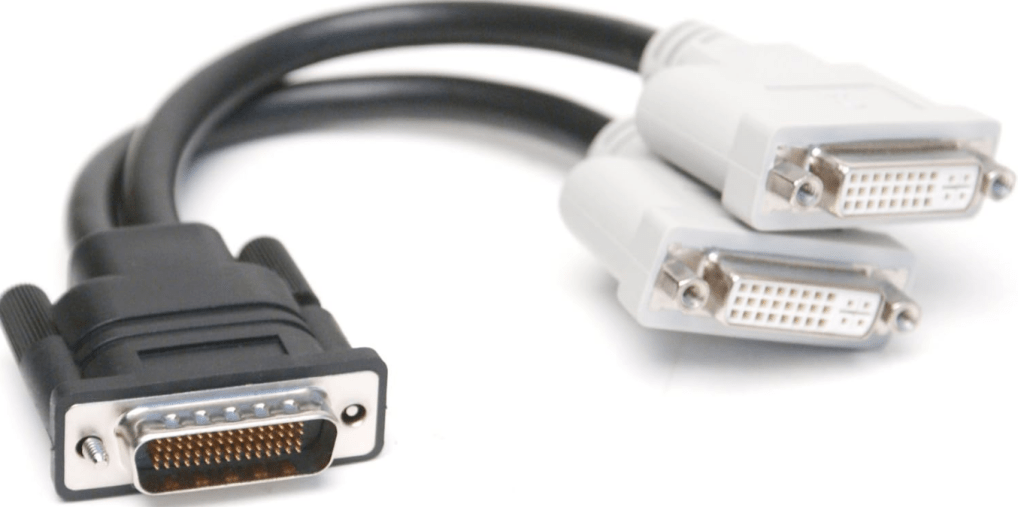
The LFH60 is a 60-pin connector interface (arranged in a rectangular pattern of 4 rows and 15 columns), commonly used in workstation computers and professional graphics cards. LFH60 (dual DVI-D) typically refers to devices or cables that convert an LFH60 interface into two DVI-D interfaces, primarily designed for video signal conversion and output. Here is a detailed overview:
Function and Purpose
- The LFH60 interface can split a single port into two or four DVI outputs. Cables or adapters labeled “LFH60 (dual DVI-D)” convert the signal from an LFH60 port into two DVI-D signals, enabling connection to two DVI-D-compatible displays. This facilitates dual-monitor setups, making it ideal for workstations or professional graphics processing scenarios requiring multi-screen displays.
Compatible Devices
- Several graphics card models from Matrox support the LFH60 interface, such as the G200/G450 multi-monitor series, Millennium G550 dual DVI, and Millennium P650 lp PCIe 128. LFH60 (dual DVI-D) cables are designed to work with these graphics cards.
Cable Characteristics
- Commercial LFH60-to-dual-DVI-D cables are typically made of copper, ensuring reliable signal transmission. They are available in various lengths, with 0.32 meters being a common option, allowing users to choose based on their specific setup requirements.
In summary, LFH60 (dual DVI-D) solutions play a key role in expanding display capabilities for professional systems, enabling efficient multi-monitor configurations critical for tasks like graphic design, video editing, and data analysis. a key role in early high-performance computing, bridging the gap between systems and peripherals with improved speed and versatility compared to its predecessor (SCSI-1). Though replaced by newer interfaces like SATA and USB in mainstream use, it remains relevant in legacy industrial and retro computing setups.





















Leave a comment