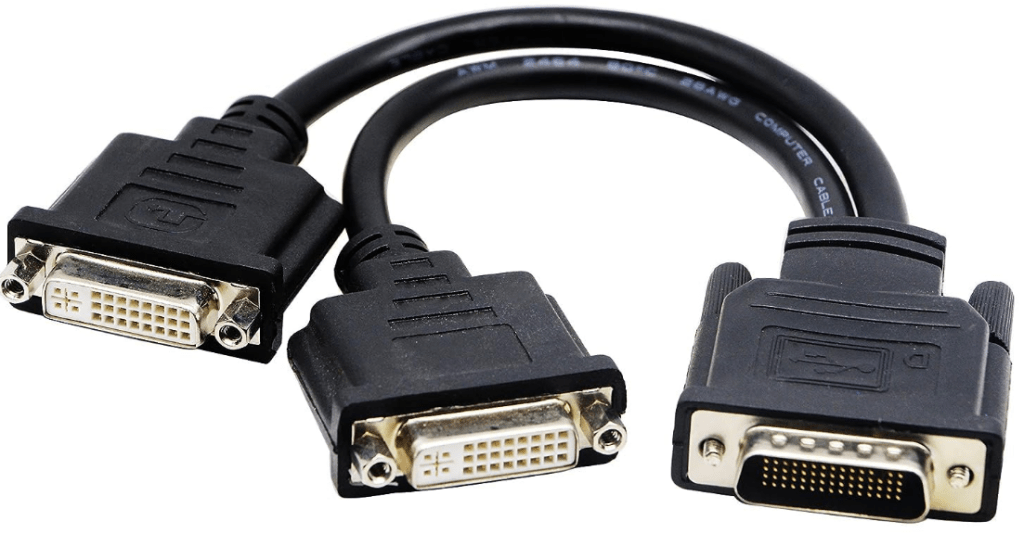
DMS59 (Dual Monitor Signal 59) is a 59-pin proprietary connector designed to support multi-monitor setups, commonly used in professional graphics cards, workstations, and older laptops. As the name suggests, DMS59 (dual DVI-D) refers to configurations where this 59-pin interface is converted into two DVI-D outputs, enabling dual-display connectivity. Below is a detailed breakdown:
1. Core Function and Design
- 59-Pin Configuration: The DMS59 connector features 59 pins arranged in a compact, rectangular housing (typically 2 rows of 29 and 30 pins), designed to carry multiple video signals in a single port.
- Dual DVI-D Conversion: DMS59 is engineered to split its integrated signals into two independent DVI-D (Digital Visual Interface – Digital) outputs. This allows a single DMS59 port to drive two DVI-D-compatible displays, supporting resolutions up to 1920×1200 (or higher, depending on the graphics card’s capabilities).
2. Applications and Use Cases
- Professional Graphics Cards: Widely adopted in mid-range to high-end graphics cards from manufacturers like AMD (ATI), NVIDIA, and Matrox, particularly in models optimized for multi-monitor workflows (e.g., video editing, 3D modeling, financial trading).
- Workstations and Laptops: Used in older workstation computers and business laptops (e.g., Dell Precision, HP ZBook series) to enable dual external displays without requiring multiple physical ports, saving space.
- Dual-Monitor Setups: Ideal for scenarios requiring extended desktops, mirrored displays, or independent content on two screens, leveraging DVI-D’s digital signal for sharp, noise-free image quality.
3. Cables and Adapters
- DMS59 to Dual DVI-D Cables: The primary accessory for this configuration is a cable that converts the 59-pin DMS59 connector into two DVI-D ports (usually male DVI-D connectors). These cables are shielded to minimize signal interference and ensure stable transmission.
- Compatibility: While DMS59 is often associated with DVI-D, some adapters also support conversions to VGA, HDMI, or DisplayPort, though dual DVI-D remains the most common use case for digital-only setups.
4. Advantages
- Space Efficiency: Consolidates two DVI-D signals into a single port, reducing the number of connectors on graphics cards or laptops—critical for compact designs.
- Cost-Effective: Eliminates the need for multiple discrete ports, lowering manufacturing costs for hardware while maintaining multi-display functionality.
- Digital Signal Integrity: DVI-D conversion preserves digital video quality, avoiding analog-to-digital conversion losses compared to VGA setups.
5. Limitations
- Proprietary Design: DMS59 is not a universal standard, limiting compatibility to devices specifically engineered to support it.
- Resolution Constraints: Older implementations may cap resolution at 1920×1200 per display, insufficient for modern 4K monitors (though newer variants may support higher resolutions).
- Replacement by Modern Standards: Gradually phased out in favor of DisplayPort and HDMI, which natively support multi-stream transport (MST) for daisy-chaining displays without adapters.
6. Legacy and Current Use
- Decline in New Hardware: As DisplayPort and HDMI dominate modern graphics cards and monitors, DMS59 is primarily found in legacy systems.
- Retrofit and Maintenance: Still used in older workstations or industrial setups, with cables/adapters readily available for maintaining dual-display configurations.
Conclusion
DMS59 (dual DVI-D) was a practical solution for enabling multi-monitor setups in professional and compact systems, offering space-efficient digital connectivity. Though overshadowed by newer standards like DisplayPort, it remains a notable part of video interface history, valued for its role in simplifying dual-display workflows in older hardware.





















Leave a comment