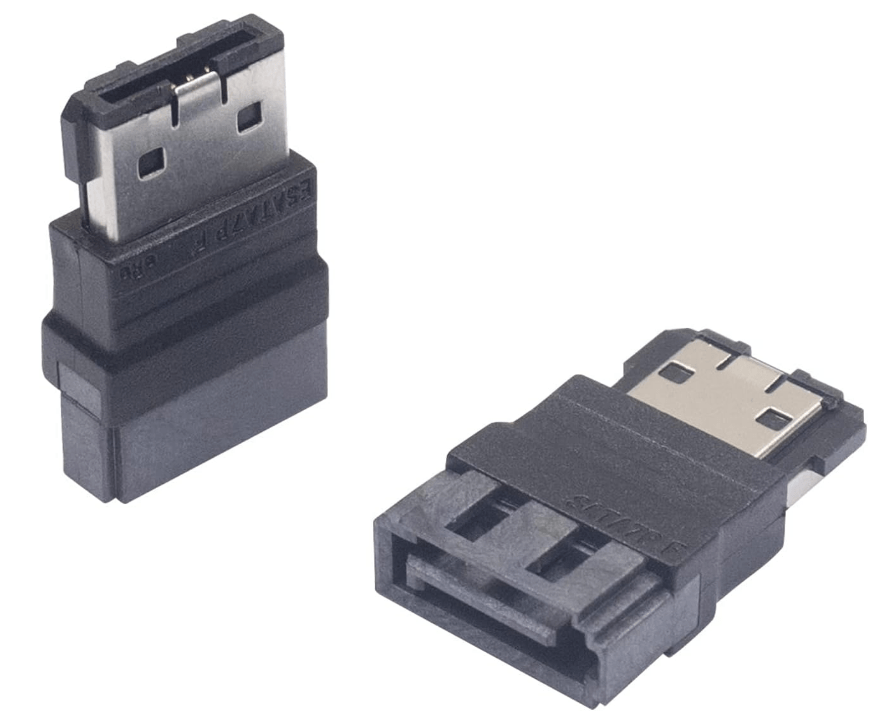
1. Definition and Development
e-SATA (external Serial ATA) is an extension of the SATA (Serial ATA) interface, designed for connecting external storage devices (e.g., hard drives, optical drives) to computers. Developed by the Serial ATA International Organization (SATA-IO) in 2004, it addresses the bandwidth limitations of USB 2.0 and Firewire 400 by enabling native SATA speeds for external devices.
2. Physical Connector and Cable
- Connector Design:
- e-SATA uses a specialized 7-pin connector, distinct from internal SATA’s 15-pin power+data connector. The e-SATA port is often labeled “eSATA” on computers and enclosures.
- The connector is L-shaped to prevent incorrect insertion, with pins for data transmission (no built-in power supply).
- Cable Specifications:
- e-SATA cables are shielded to reduce interference, with a maximum length of 2 meters (vs. 1 meter for internal SATA), though high-quality cables may support up to 5 meters.
3. Technical Specifications and Performance
- Data Transfer Rates:
- Compatible with all SATA generations:
- SATA I (1.5 Gbps): 150 MB/s
- SATA II (3.0 Gbps): 300 MB/s
- SATA III (6.0 Gbps): 600 MB/s
- Significantly faster than USB 2.0 (480 Mbps/60 MB/s) and Firewire 800 (800 Mbps/100 MB/s), approaching the speed of internal SATA drives.
- Compatible with all SATA generations:
- Power Considerations:
- e-SATA does not provide power, so external devices require a separate power adapter (e.g., 12V DC for hard drives) or a powered enclosure.
4. Comparison with Other External Interfaces
| Interface | Max Speed | Power Delivery | Cable Length | Use Case |
|---|---|---|---|---|
| e-SATA III | 600 MB/s | None | 2 meters | High-speed external storage |
| USB 3.0 | 625 MB/s | 900 mA @ 5V | 5 meters | General-purpose peripherals |
| Firewire 800 | 100 MB/s | Limited | 4.5 meters | Legacy audio/video equipment |
| Thunderbolt 3 | 40 Gbps | Up to 100W | 0.5 meters (copper) | High-performance computing |
5. Advantages of e-SATA
- Speed and Performance:
- Matches internal SATA speeds, ideal for transferring large files (e.g., 4K videos, virtual machines) without bottlenecks.
- Low Latency:
- Minimal protocol overhead compared to USB, making it suitable for real-time applications like video editing or gaming.
- Plug-and-Play:
- No drivers needed for basic functionality, compatible with most operating systems (Windows, macOS, Linux).
6. Limitations and Decline
- No Built-in Power:
- Requirement for external power adapters increased cable clutter, limiting convenience for portable devices.
- Competition from USB 3.0/Thunderbolt:
- USB 3.0’s 普及 (with power delivery and longer cables) and Thunderbolt’s higher speeds made e-SATA less appealing for manufacturers.
- Physical Fragility:
- e-SATA connectors were more prone to damage than USB or HDMI, especially in portable enclosures.
7. Applications and Modern Relevance
- Historical Use Cases:
- External hard drives and SSDs in the 2000s–2010s, particularly for desktop computers and professional storage setups.
- RAID enclosures and optical drives requiring high-speed external connectivity.
- Niche Current Use:
- Some legacy NAS devices and industrial storage systems still use e-SATA for backward compatibility.
- Vintage computing enthusiasts may use e-SATA for the fastest possible external storage on older systems.
8. e-SATA vs. Internal SATA
- Similarities:
- Identical data transfer protocols and speeds, enabling seamless performance for external drives.
- Differences:
- e-SATA: External connector, longer cable (2m), no power supply.
- Internal SATA: 15-pin connector with power, shorter cable (1m), integrated into motherboards.
9. Transition to Modern Interfaces
- USB 3.0/3.2: Replaced e-SATA in consumer devices due to universal adoption, power delivery, and compatibility with USB Type-C.
- e-SATAp (Powered e-SATA): A rare hybrid interface combining e-SATA and USB 2.0 for power, but it failed to gain traction.
- M.2 and NVMe: Internal SSDs with faster interfaces (PCIe) made external storage speeds less of a bottleneck for most users.
Conclusion
e-SATA played a pivotal role in enabling high-speed external storage before the rise of USB 3.0 and Thunderbolt. Though obsolete in modern consumer electronics, its legacy lies in proving the feasibility of native SATA speeds for external devices. Today, it serves as a reminder of the interface wars in the storage industry, with convenience and universal connectivity ultimately overshadowing pure speed in mainstream adoption.





















Leave a comment