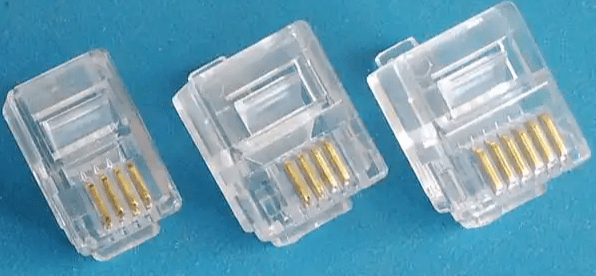
1. RJ-11 Connector: Physical and Functional Overview
The RJ-11 (Registered Jack-11) is a standardized modular connector used for telephone networks, featuring 4 or 6 pins (though 6-pin variants are less common). It is smaller than the RJ-45 Ethernet connector, typically used for terminating twisted-pair cables in analog phone lines, DSL modems, and legacy telecommunication devices.
2. Pin Configuration and Wiring
- Common 4-Pin RJ-11:
- Pins 1 and 4 are commonly used for the telephone line, carrying the analog voice signal (Tip and Ring wires).
- Pin 2 and 3 are often unused in basic phone connections but may be used for additional lines in multi-line setups.
- Wiring Example:
- Pin 1: Red wire (Ring)
- Pin 4: Green wire (Tip)
3. Role in Modem Technology
A modem (short for “modulator-demodulator”) converts digital data from a computer into analog signals for transmission over telephone lines (and vice versa). RJ-11 connects the modem to the wall jack, enabling:
- Analog Dial-Up Modems:
- Historic technology (1990s–2000s) that transmitted data at speeds up to 56 kbps. The RJ-11 connected the modem to the phone line, allowing internet access via analog voice channels.
- DSL Modems:
- Digital Subscriber Line (DSL) uses RJ-11 to connect to the phone line, splitting the line into voice (POTS) and data channels. DSL modems support faster speeds (up to 100 Mbps for VDSL2), using the same RJ-11 interface but with digital signal processing.
4. DSL Modem-RJ-11 Integration
- Physical Connection:
- One end of the RJ-11 cable plugs into the “Line” port on the DSL modem, while the other connects to the telephone wall jack.
- A second RJ-11 cable may connect the modem’s “Phone” port to a telephone, allowing simultaneous voice and data use.
- Signal Processing:
- DSL modems use frequency division:
- Low frequencies (0–4 kHz) for voice calls (POTS).
- Higher frequencies (25 kHz–1.1 MHz for ADSL, up to 30 MHz for VDSL2) for data, enabling concurrent use of the same RJ-11 line for both.
- DSL modems use frequency division:
5. Advantages of RJ-11 in Modems
- Widespread Availability: RJ-11 ports are standard in telephone wall jacks, making DSL modems easy to install in homes and offices.
- Cost-Effectiveness: Leverages existing telephone infrastructure, reducing deployment costs compared to fiber or cable networks.
- Dual Use: Supports simultaneous voice and data transmission, ideal for households without separate data lines.
6. Limitations and Decline
- Speed Constraints:
- Dial-up modems maxed out at 56 kbps, while DSL speeds depend on distance from the phone company’s central office (slower over longer wires).
- Bandwidth Limitation:
- Inadequate for modern high-bandwidth needs (streaming, gaming), leading to adoption of cable modems (RJ-45), fiber (SC/LC connectors), or wireless.
- Legacy Technology:
- RJ-11-based modems are less common in urban areas, though still used in rural regions where fiber/cable isn’t available.
7. Modern Relevance
- VDSL2 and ADSL2+:
- RJ-11 remains the interface for these DSL variants, supporting speeds up to 100 Mbps (VDSL2) in short-range scenarios.
- Fallback Solutions:
- Some remote offices or IoT devices use RJ-11 modems as backup connectivity when primary broadband fails.
- Home Phone Systems:
- RJ-11 still connects analog phones to VoIP modems or traditional phone lines, even in homes with broadband.
8. Comparison with Other Modem Interfaces
| Interface | Technology | Speed Range | Use Case |
|---|---|---|---|
| RJ-11 | DSL, dial-up | 56 kbps–100 Mbps | Legacy phone lines, rural broadband |
| RJ-45 | Cable modem, Ethernet | 10 Mbps–10 Gbps | Cable internet, LAN connections |
| SC/LC | Fiber optic | 100 Mbps–100 Gbps+ | Fiber-to-home (FTTH), data centers |
Summary
The RJ-11 connector has been integral to modem technology, enabling analog dial-up and DSL internet access through existing telephone lines. While overshadowed by faster interfaces in modern networks, it persists in DSL deployments and legacy telecommunication setups, highlighting its role as a bridge between traditional phone systems and early broadband connectivity.





















Leave a comment