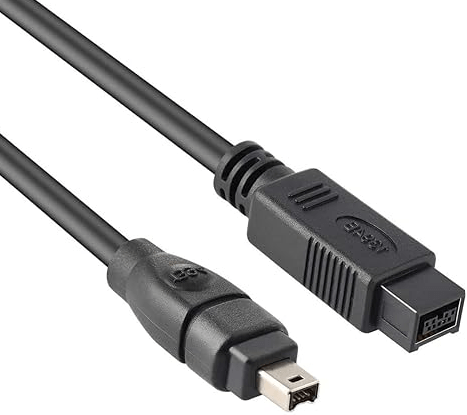
1. IEEE 1394b (Firewire 800): Core Improvements
- Bandwidth Enhancement
- Introduced in 2002, 1394b increased data rates to 800 Mbps (100 MB/s), later expandable to 1.6 Gbps and 3.2 Gbps with fiber optic cables. This addressed the 400 Mbps bottleneck of 1394a for high-definition video and multi-track audio.
- Physical Layer Upgrades
- New Connector: The 9-pin beta connector (smaller than 6-pin) with improved EMI shielding, though backward-compatible with 6-pin/4-pin via adapters.
- Cable Options:
- Copper cables: Maximum 4.5 meters at 800 Mbps, reduced to 2 meters at 1.6 Gbps.
- Fiber optic cables: Extended distance to 100 meters, ideal for professional setups.
- Power Delivery
- Maintained 6-pin power support (up to 30V/1.5A) but added power management features for better energy efficiency.
2. IEEE 1394c (Firewire 3200): Modern Adaptation
- Electrical Compatibility
- Released in 2013, 1394c standardizes Firewire over RJ-45 Ethernet cables, allowing use of cheaper CAT-5/6 wiring. This aimed to reduce costs and simplify integration in consumer electronics.
- Speed Scaling
- Supports up to 3.2 Gbps (400 MB/s) over copper, matching Thunderbolt 1’s bandwidth but with lower implementation costs.
- Protocol Enhancements
- Integrates with existing 1394b software stacks, enabling plug-and-play with legacy devices while leveraging modern cabling.
3. Technical Features Compared to 1394a
| Aspect | 1394a (Firewire 400) | 1394b (Firewire 800) | 1394c (Firewire 3200) |
|---|---|---|---|
| Max Speed | 400 Mbps (50 MB/s) | 3.2 Gbps (400 MB/s, fiber) | 3.2 Gbps (copper via RJ-45) |
| Connector | 6-pin/4-pin | 9-pin beta (backward-compatible) | RJ-45 (CAT-5/6) |
| Cable Length | 4.5m (copper) | 4.5m (copper at 800 Mbps) | 100m (CAT-6 at 1.6 Gbps) |
| Power Support | 6-pin: 8–40V DC | Same as 1394a, with power management | Same as 1394b, via existing pins |
| Key Innovation | Initial high-speed serial bus | Fiber optic support, higher speeds | Low-cost cabling, Ethernet compatibility |
4. Applications of Firewire 800/3200
- Professional Video/Audio
- 1394b was adopted in:
- High-definition camcorders (e.g., Sony XDCAM, Canon XF series) for uncompressed video transfer.
- Studio audio interfaces (e.g., Apogee Symphony, RME Fireface) for multi-channel recording (up to 128 channels).
- 1394b was adopted in:
- External Storage
- Firewire 800 hard drives/RAID systems (e.g., LaCie Big Disk) offered faster transfers than USB 2.0, targeting video editors and photographers.
- Scientific/Industrial Use
- 1394b’s deterministic data flow made it suitable for robotics, medical imaging, and real-time control systems.
- 1394c in Niche Markets
- Used in automotive infotainment systems and industrial IoT for its balance of speed and ruggedness.
5. Decline and Competition
- USB 3.0/Thunderbolt Dominance
- USB 3.0 (5 Gbps) surpassed Firewire 800 in speed and cost, while Thunderbolt (10 Gbps+) combined PCIe and DisplayPort for broader compatibility.
- Complex Implementation
- Firewire’s protocol required dedicated chipsets, whereas USB/Thunderbolt leveraged existing motherboard controllers.
- Consumer Shift
- Digital cameras and laptops (e.g., MacBook Air) phased out Firewire ports, favoring USB-C/HDMI for video and USB for storage.
6. Modern Relevance
- Legacy Equipment
- Older video editing suites and audio studios still use Firewire 800 interfaces for compatibility with archived projects.
- Specialized Systems
- Some legacy scientific instruments and industrial machines rely on 1394b for deterministic data transfer.
- Adapters and Bridges
- Firewire-to-USB 3.0/Thunderbolt adapters allow modern computers to connect with vintage devices, though speed is limited to Firewire’s maximum.
7. Technical Legacy
- Influence on Thunderbolt
- 1394b’s isochronous transfer and hot-plugging inspired Thunderbolt’s design, particularly in real-time media workflows.
- Serial Bus Architecture
- Pioneered the concept of high-speed serial data with low latency, which became standard in USB 3.0, PCIe, and SATA.
Summary
Firewire 800/3200 (1394b/c) represented the evolution of high-speed serial connectivity for multimedia, addressing the bandwidth limitations of earlier Firewire versions. Though overshadowed by USB and Thunderbolt in consumer markets, their legacy endures in professional audio/video equipment and specialized industries, highlighting their role as a bridge between legacy technologies and modern high-speed interfaces.





















Leave a comment