Modern Relevance and Legacy
Legacy Device Support:
Still used in older camcorders, audio interfaces, and Macs (e.g., PowerBook G4), requiring adapters (Firewire to Thunderbolt/USB-C) for compatibility with modern systems.
Niche Markets:
Some vintage audio enthusiasts and video archivists rely on Firewire 400 for connecting legacy equipment.
Technological Predecessor:
Laid the groundwork for high-speed serial interfaces, influencing the development of Thunderbolt (which shares architectural similarities).
Summary
Firewire 400 (IEEE 1394a) was a groundbreaking technology for real-time multimedia transfer, defining standards for digital video and audio in the 2000s. Though replaced by faster interfaces today, its legacy persists in specialized equipment, showcasing its role as a critical bridge between analog and digital media workflows.
Standard Definition and Development
Firewire 400, formally known as IEEE 1394a, is a high-speed serial bus standard developed in the 1990s to enable real-time data transfer for multimedia devices. It was pioneered by Apple (branded as “Firewire”) and standardized by the Institute of Electrical and Electronics Engineers (IEEE), with Sony marketing it as “iLink” in consumer products.
Data Transfer Speed and Protocol
Bandwidth:
Transmits data at 400 Mbps (50 MB/s), which was revolutionary for its era (outpacing USB 2.0’s 480 Mbps in practical throughput due to lower protocol overhead).
Transfer Modes:
Isochronous Transfer: Prioritizes real-time data streaming (e.g., video, audio) with consistent bandwidth, minimizing latency.
Asynchronous Transfer: Supports traditional file transfers and command-based communications.
Bus Architecture:
Enables daisy-chaining of up to 63 devices without hubs, with a maximum cable length of 4.5 meters per segment (or longer with repeaters).
Connector Types and Power Delivery
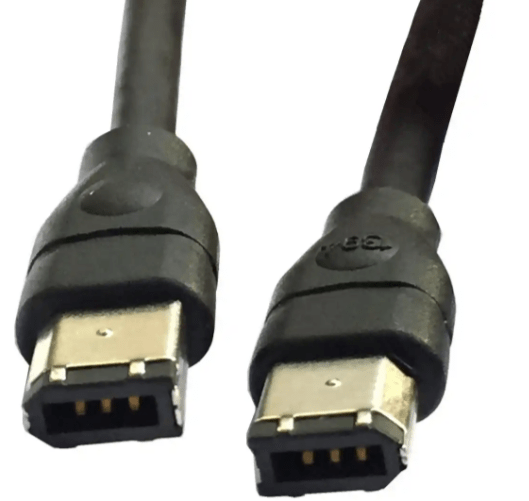
6-Pin Connector (Standard):
Includes four data pins and two power pins (providing 8–40V DC, up to 1.5A), ideal for bus-powered devices like external hard drives.
4-Pin Connector (Compact):
Omits power pins, used in portable devices (e.g., camcorders, audio interfaces) to save space. Requires external power for connected peripherals.
Cable Design:
Twisted-pair wires for data and shielded conductors for power (in 6-pin), reducing electromagnetic interference.
Key Applications in Media and Technology
Digital Video Production:
Primary interface for transferring DV (Digital Video) and HDV footage from camcorders (e.g., Sony, Canon) to computers, replacing analog video cables.
Professional Audio Equipment:
Used in audio interfaces (e.g., Focusrite, MOTU) for low-latency multi-track recording, supporting up to 64 channels of digital audio.
External Storage:
Early Firewire 400 hard drives offered faster transfer speeds than USB 2.0, appealing to video editors and photographers.
Apple Ecosystem:
Integrated into Mac computers (1999–2010) for seamless connectivity with camcorders, audio gear, and peripherals.
Advantages Over Contemporary Technologies
Real-Time Performance:
Isochronous transfer ensured smooth video/audio streaming, critical for live recording or editing where USB 2.0 often introduced lag.
Plug-and-Play Simplicity:
Hot-plugging without system reboots, with automatic device detection and configuration.
Device Chaining:
Allowed direct connection of multiple devices (e.g., camera → hard drive → monitor) without intermediate hubs, simplifying setups.
Limitations and Decline
Bandwidth Constraints:
Struggled with emerging 4K video and high-resolution audio, prompting the development of Firewire 800 (IEEE 1394b).
Power Delivery Limits:
6-pin’s 1.5A power output was insufficient for power-hungry devices, requiring external adapters.
Cost and Competition:
Firewire chipsets were more expensive than USB, and USB 3.0 (5 Gbps) and Thunderbolt (10 Gbps+) eventually outpaced it in speed and affordability.
Industry Transition:
Digital cameras shifted to USB 3.0/HDMI, and audio equipment adopted USB-C or Thunderbolt for higher bandwidth and power delivery.





















Leave a comment