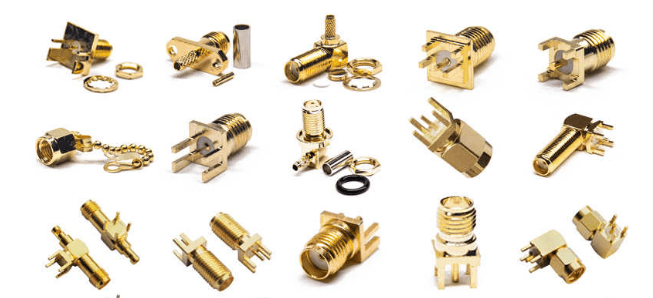
SMA connectors are widely used small threaded coaxial connectors, with the most commonly used being 3.5mm and 2.92mm connectors. How should one choose between them in different scenarios, and what performance changes occur during use? What are the performance differences between SMA, 3.5mm, and 2.92mm connectors? Next, the engineer will explain the performance differences between SMA, 3.5mm, and 2.92mm connectors.
Performance differences are as follows:
A notable difference between 3.5mm connectors and SMA connectors (including Southwest Microwave’s “Super SMA”) is that 3.5mm connectors use an air medium. The outer conductor of a 3.5mm connector is thicker than that of an SMA connector, resulting in better mechanical strength. Therefore, not only does it have superior electrical performance compared to SMA connectors, but it also offers higher mechanical durability and performance repeatability, making it more suitable for use in the testing industry.
The 2.92mm connector has very high operational reliability. Since the 2.92mm connector has four slots in the socket and good elasticity, with an insertion force of only 0.5 pounds (2.224N), the wear on the inner conductor of the K-type connector is significantly reduced, and reliability is improved by approximately 12 times. Additionally, the conductor wall thickness of the K-type connector is four times thicker than that of the SMA connector, resulting in the reliability of the K-type connector being approximately 30 times higher than that of the SMA connector.





















Leave a comment