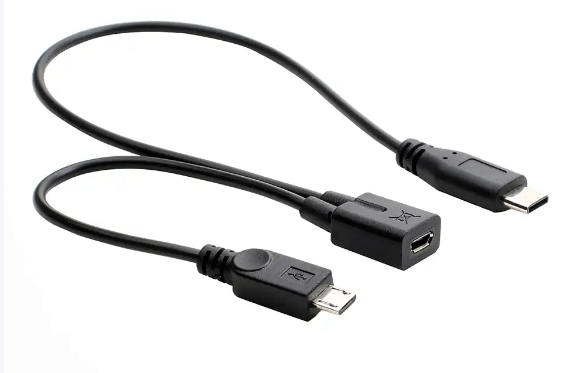
I. Definition and Development Background
The USB Micro interface is a miniaturized USB connector standard introduced in 2007, succeeding the bulkier USB Mini interface. Developed to meet the demand for thinner portable devices (e.g., smartphones, tablets), it became the global charging and data transfer standard for mobile electronics until the rise of USB-C. Key milestones:
- USB Implementers Forum (USB-IF) approval: 2007 for Micro-B, 2010 for Micro-AB.
- Main goal: Replace Mini-USB with a slimmer, more durable design for emerging smartphones (e.g., early Android devices).
II. Key Types and Physical Characteristics
1. USB Micro-B Interface
- Design:
- Trapezoidal shape with a rounded top, ~2.1 mm thickness (30% thinner than Mini-USB).
- Receptacle features a “lip” to prevent misinsertion, though not fully reversible (unlike USB-C).
- Pin Configuration (5-pin standard):
- Pin 1 (VCC): +5V power (up to 500mA in USB 2.0, later upgraded to 1.5A via BC 1.2).
- Pins 2-3 (Data±): USB 2.0 data transmission (480 Mbps max).
- Pin 4 (GND): Ground.
- Pin 5 (ID): For OTG (On-The-Go) functionality, identifying device role (host/device).
2. USB Micro-AB Interface
- Dual-compatibility:
- Allows both Micro-A and Micro-B plugs to connect, enabling devices to switch between host and slave modes (e.g., smartphones acting as USB hosts for peripherals).
- Practical use: Rare in consumer devices, mostly in specialized OTG hubs or legacy industrial equipment.
III. Technical Capabilities and Upgrades
- Data Transfer and Charging
- USB 2.0: Max 480 Mbps for syncing files (e.g., music, photos) in early smartphones.
- Charging evolution:
- Standard 5V/500mA (2.5W) initially; later supported 5V/1.5A (7.5W) via BC 1.2 charging protocols.
- Limited fast charging: Some manufacturers (e.g., Qualcomm) introduced proprietary protocols (e.g., Quick Charge 1.0) via Micro-B, but max power remained <10W.
- Durability
- Rated for ~10,000 insertion cycles, surpassing Mini-USB’s ~5,000 cycles—a key advantage for frequent charging.
IV. Application Scenarios and Market Dominance
- Prime Era (2008–2016):
The default interface for:- Smartphones: Android devices (e.g., Samsung Galaxy S series, HTC One), early Windows Phone models.
- Tablets: Kindle Fire, early Android tablets (before USB-C adoption).
- Peripherals: Bluetooth speakers, portable chargers, fitness trackers (e.g., Fitbit Charge 2).
- Industrial Devices: Handheld scanners, medical monitors, IoT sensors.
- Reasons for Success:
- Slim profile: Fit into thin devices like the 7.7mm-thick Samsung Galaxy S II.
- OTG support: Enabled smartphones to connect to USB drives or keyboards without adapters.
- Standardization: Adopted by major manufacturers, replacing fragmented charging ports (e.g., Nokia’s proprietary jacks).
V. Decline and Replacement by USB-C
- Limitations leading to obsolescence:
- Non-reversible: Still required correct insertion direction, unlike USB-C’s universal orientation.
- Slow data/charging: Incompatible with USB 3.0 (requires Micro-B SuperSpeed, rarely adopted) and modern fast charging (e.g., PD’s 65W+).
- Mechanical flaws: Fragile pins in some low-quality cables, prone to bending or corrosion.
- Transition period (2015–present):
- First movers: Google Nexus 5X/6P (2015) and Apple iPad Pro (2018) adopted USB-C.
- Regulatory push: EU’s 2024 mandate requiring USB-C in smartphones accelerated Micro-USB phase-out.
VI. Current Status and Legacy Use
- Niche applications:
- Older devices: Feature phones, some budget Android smartphones (2023 models in emerging markets).
- Industrial equipment: Printers, POS machines, older CCTV cameras.
- Wearables: Some low-cost fitness trackers or remote controls.
- Adapter solutions:
- Micro-B to USB-A cables for connecting old devices to modern chargers.
- Micro-B to USB-C adapters for data transfer in legacy smartphones.
VII. Conclusion
The USB Micro interface was a pivotal standard in mobile technology, enabling the slim design of early smartphones and driving universal charging compatibility. Though replaced by USB-C, its legacy endures in millions of existing devices. Its story exemplifies tech evolution: balancing miniaturization, functionality, and standardization until superior designs (like USB-C’s reversibility and high power) emerge.





















Leave a comment