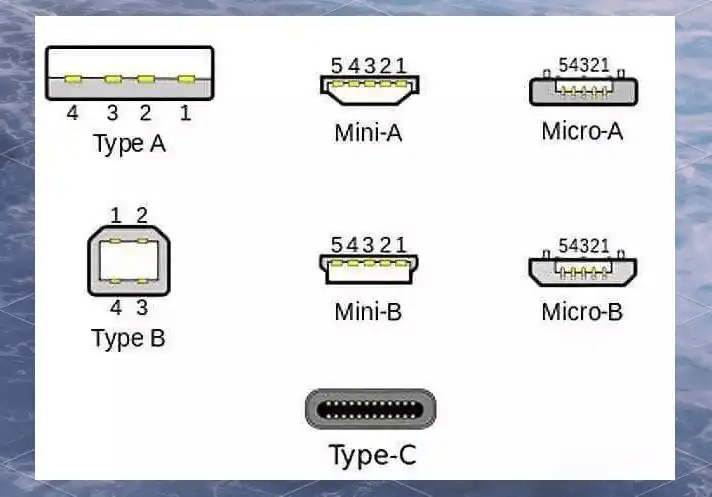
Have you ever wondered what exactly the Type-C interface is? Why is it so highly regarded in today’s tech world? As more and more devices adopt this interface—such as the recently released new models, nearly all of which come standard with Type-C data cables—its status as a standard configuration is now unshakable. But what exactly is Type-C, and what are its advantages? Let’s uncover its mysteries together.
△ Features and Advantages of Type-C
Type-C is a new type of connector with a unique design that allows for easy insertion without distinguishing between the front and back sides, measuring approximately 8.3mm × 2.5mm. In addition to supporting standard charging, data transmission, and display output functions, the Type-C interface offers numerous advantages. Due to its novelty and convenience, the Type-C interface is expected to quickly become a popular trend in the tech industry, with many new models, such as recently released devices, already adopting this interface.
△ Comparison with Other Interface Types
When discussing interface types, the “Type” in Type-C refers to the interface type itself. By comparison, we can see that the interfaces commonly used in computers belong to Type-A, while Type-B interfaces are more commonly found in devices like printers. In contrast, the Type-C interface will undoubtedly become the mainstream choice in the future. Some people refer to the Type-C interface as the USB-C interface. Here, “USB” actually refers to the standard specifications the interface follows. For example, the USB 2.0 and USB 3.0 interfaces commonly used in computers represent different specification versions.
02
Technical specifications and performance of Type-C
△ Data transfer speed and power supply capability
The Type-C interface not only offers high speeds of up to 5Gbps or 10Gbps but also boasts an impressive power delivery capability of up to 100W. Additionally, the Thunderbolt 3 interface utilizes Type-C technology, achieving data transfer speeds of up to 40Gbps while supporting video transmission and dual 4K output, offering comprehensive functionality.
△ Design Innovation and User Experience
One of the most exciting aspects of the Type-C interface is that it addresses a long-standing issue with USB interfaces: directionality. Whether inserted right-side up or upside down, it can be easily plugged in without the need for tedious adjustments. This design innovation makes the Type-C interface more convenient than other interfaces, particularly for everyday use and applications on mobile devices like smartphones.
03
The Evolving Role of Type-C in Smartphone Applications
△ Trend Toward Reduced Interface Count and Enhanced Applications
In this era of simplicity and efficiency, smartphone manufacturers are increasingly focused on reducing the number of interfaces on their devices. As the 3.5mm headphone jack is phased out, the charging port naturally takes on the role of connecting to plug-in headphones. Fortunately, the Type-C interface not only supports high-speed transmission of audio and video files but also receives widespread praise from both manufacturers and users for its exceptional quality.
△ User Feedback and Future Trends
Today, Micro ports are increasingly rare, with Type-C ports now dominating the market. However, some users remain skeptical about Type-C ports, primarily because many Type-C smartphones have eliminated the headphone jack, making it impossible to enjoy music while charging without using an adapter cable. So, which port best aligns with your expectations?





















Leave a comment