Quick Tip #2: Power (Full) Options
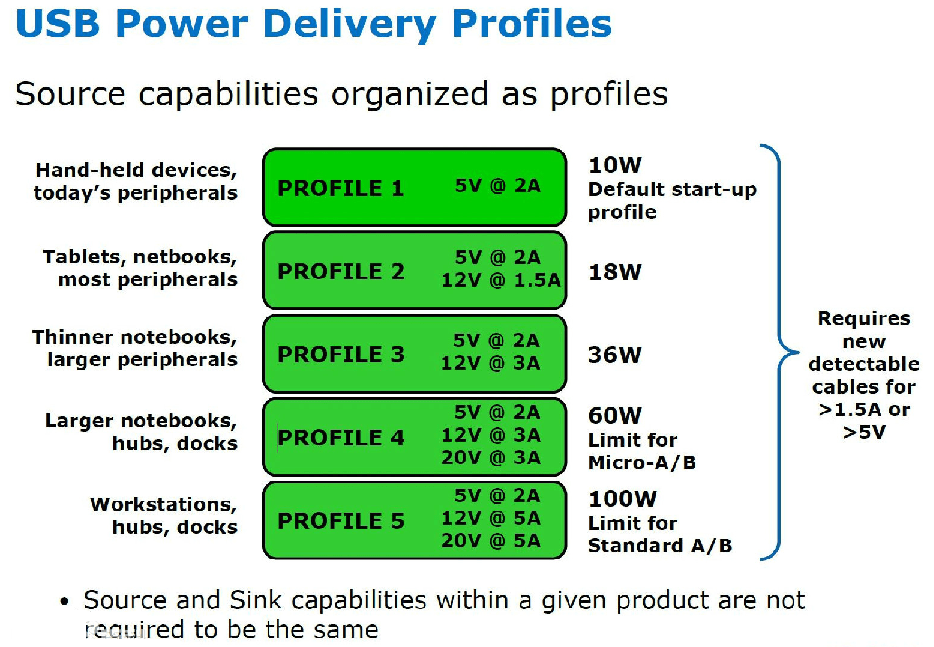
The new Type-C connector can handle up to 100W of power to supply displays or charge larger devices like laptops, notebooks, or 2-in-1s (Figure 6). Additionally, power can flow in either direction, so your smartphone can charge your laptop (for short periods). The USB-IF BC1.2 (Battery Charge) specification covers previous USB charging schemes (see “How USB Charges Any Electronic Device” in this article). The new Type-C specification is covered in the Power Delivery 2.0 (PD) specification (see “Three Essential Technologies for Ultra-Mobile, Portable Embedded Systems”).
1611298636281

Determining power requirements, selecting voltage, and choosing current delivery mechanisms under the PD specification is complex and based on USB-IF protocols (readers are encouraged to consult the aforementioned articles). Table 2 lists key power options in Type-C according to the PD specification.
Notably, observe how the new 100W (bidirectional) PD option coexists with the traditional BC1.2 specification. Designers must understand their system’s power delivery requirements and incorporate necessary charging, switching, and enumeration circuits. Beyond the latest PD specification, maximum USB power remains 15W (5V@3.0A), sufficient for all handheld mobile devices, portable hard drives, and USB accessories. Only laptops and displays (potentially not “embedded systems”) may require >50W .
- iPhone 15 Pro Review: Ultimate Features and Specs
- iPhone 15 Pro Max: Key Features and Specifications
- iPhone 16: Features, Specs, and Innovations
- iPhone 16 Plus: Key Features & Specs
- iPhone 16 Pro: Premium Features & Specs Explained
- iPhone 16 Pro Max: Features & Innovations Explained
- iPhone 17 Pro: Features and Innovations Explained
- iPhone 17 Review: Features, Specs, and Innovations
- iPhone Air Concept: Mid-Range Power & Portability
- iPhone 13 Pro Max Review: Features, Specs & Performance
- iPhone SE Review: Budget Performance Unpacked
- iPhone 14 Review: Key Features and Upgrades
- Apple iPhone 14 Plus: The Ultimate Mid-range 5G Smartphone
- iPhone 14 Pro: Key Features and Innovations Explained
- Why the iPhone 14 Pro Max Redefines Smartphone Technology
- iPhone 15 Review: Key Features and Specs
- iPhone 15 Plus: Key Features and Specs Explained
- iPhone 12 Mini Review: Compact Powerhouse Unleashed
- iPhone 12: Key Features and Specs Unveiled
- iPhone 12 Pro: Premium Features and 5G Connectivity
- Why the iPhone 12 Pro Max is a Top Choice in 2023
- iPhone 13 Mini: Compact Powerhouse in Your Hand
- iPhone 13: Key Features and Specs Overview
- iPhone 13 Pro Review: Features and Specifications





















 Ruigu Electronic
Leave a comment