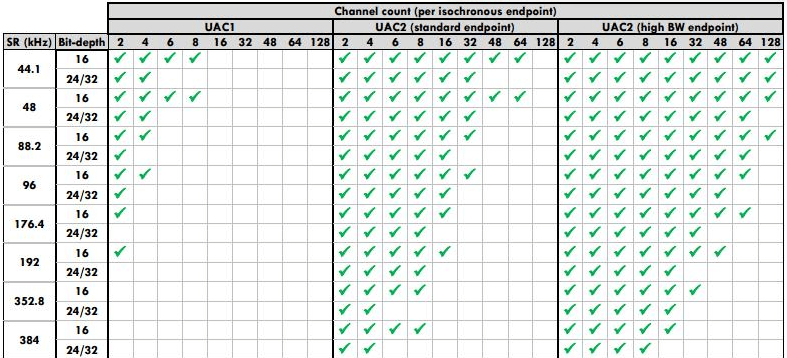
UAC 2.0 inherently offers high bandwidth and low latency advantages due to its support for USB High Speed. These advantages translate into support for Hi-Resolution Audio.
UAC 1.0 only supports up to stereo 192kHz 16-bit audio sources: (2 x 192 x 16) / 1024 = 6Mb = 6Mb / 8 = 0.75MB
UAC 2.0 can support up to 15-channel 384 kHz 32-bit audio sources: (15 x 384K x 32) / 1024 = 180 Mb = 18 Mb/8 = 3 Mb
UAC-USB Isochronous Endpoint
UAC1 Maximum speed: ≤8.2Mb/s
UAC2 Standard speed: ≤65.5Mb/s Maximum speed: ≤196.6Mb/s
The UAC 2.0 protocol provides additional functionality. It supports more device descriptions, adds clock domain, clock description, and clock control support, and incorporates sampling rate converter unit support.
The driver code already supports UAC 2.0; it remains to be seen if any UAC 2.0-compatible codecs have been developed.
At a sampling rate of 48000 Hz, 16-bit depth, and 2 channels, how much audio data can the device capture per second?
48000 Hz × 16 bits × 2 channels = 1,536,000 bits
(48000Hz × 16b × 2) / 8 = 192000 (Bytes) = 192 (KB)
192 (KB) / 1024 = 0.1875 (MB)
The device can capture 192 KB of data per second.
Calculate the maximum number of channels supported by UAC 1.0 and UAC 2.0 at 16000Hz/16bit:
UAC 1.0 High Speed channel count: 8.2Mb / (16000 x 16 / 1024 / 1024) = 8.2Mb / 0.25Mb = 32.8 = 32 (Theoretical value)
UAC 2.0 Full Speed supported channels: 65.5Mb / (16000 x 16 / 1024 / 1024) = 65.5Mb / 0.25Mb = 262 (Theoretical value)
UAC 2.0 high speed supported channel count: 196.6Mb / (16000 x 16 / 1024 / 1024) = 196.6Mb / 0.25Mb = 786 (theoretical value)





















 Ruigu Electronic
Leave a comment