USB 2.0 devices have specific bandwidth characteristics defined by the specification, which vary across different transfer types and speed modes (low-speed, full-speed, high-speed). These characteristics ensure efficient and reliable data transmission while preventing bus congestion. Below is a detailed breakdown:
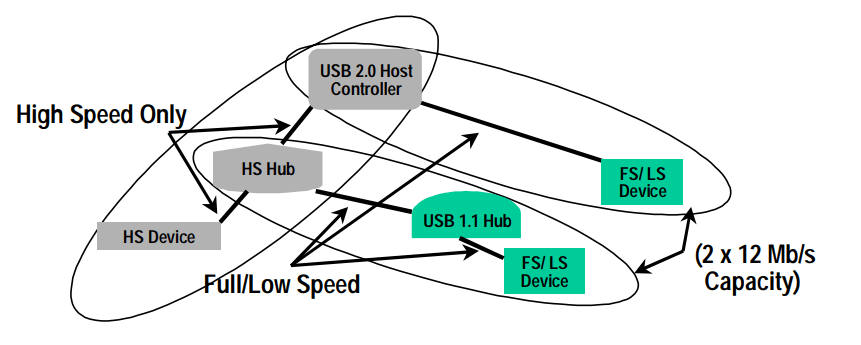
1. Overall Bandwidth Limits by Speed Mode
- Low-Speed (LS): Operates at 1.5 Mbps (megabits per second). Due to its low data rate, it is primarily used for simple devices (e.g., keyboards, mice) with minimal bandwidth requirements.
- Full-Speed (FS): Operates at 12 Mbps. It supports a wider range of devices (e.g., printers, digital cameras) and offers higher throughput than low-speed mode.
- High-Speed (HS): Operates at 480 Mbps, significantly faster than full-speed mode. It is designed for high-data-rate devices such as external hard drives, USB flash drives, and video cameras.
2. Bandwidth Allocation by Transfer Type
USB 2.0 allocates bandwidth differently based on the transfer type, prioritizing real-time data (e.g., audio/video) while ensuring reliability for other data types:
- Control Transfers:
Used for device configuration and management (e.g., enumeration, command execution). They have the lowest bandwidth priority but are guaranteed to complete. Bandwidth usage is minimal, as control data is typically small (e.g., descriptor requests via Endpoint 0). - Isochronous Transfers:
Prioritize real-time delivery (e.g., audio streams, video feeds) over error correction. They reserve a fixed amount of bandwidth to ensure consistent data flow:- Full-Speed: Up to 1023 bytes per frame (1 frame = 1ms), totaling ~8 Mbps (after accounting for overhead).
- High-Speed: Up to 1024 bytes per microframe (1 microframe = 125µs), with a maximum of 16 microframes per frame, allowing ~53 Mbps (sustained) for real-time data.
Note: Isochronous transfers do not retransmit lost data, making them suitable for time-sensitive applications where minor data loss is acceptable.
- Interrupt Transfers:
Used for devices requiring periodic, low-latency data transmission (e.g., keyboards, joysticks). They are allocated bandwidth based on their polling interval (e.g., 10ms for a mouse):- Full-Speed: Maximum packet size of 64 bytes per transfer, with bandwidth limited to ensure responsiveness without overwhelming the bus.
- High-Speed: Supports larger packets (up to 1024 bytes) and shorter polling intervals, allowing higher bandwidth for devices like touchscreens.
- Bulk Transfers:
Used for large, non-time-sensitive data (e.g., file transfers, printer data). They use remaining bandwidth after allocations for isochronous and interrupt transfers, maximizing throughput when the bus is idle:- Full-Speed: Maximum packet size of 64 bytes, with effective throughput up to ~1.5 MB/s (megabytes per second) (after protocol overhead).
- High-Speed: Maximum packet size of 512 bytes, enabling effective throughput up to ~53 MB/s (significantly higher than full-speed, though below the 480 Mbps theoretical limit due to overhead).
3. Key Bandwidth Constraints
- Overhead Considerations: The theoretical bandwidth (e.g., 480 Mbps for high-speed) includes protocol overhead (e.g., packet headers, CRC checks, bus arbitration), so actual data throughput is lower (typically ~50-60% of the theoretical limit for high-speed).
- Bus Sharing: USB is a shared bus, meaning all devices on the same bus compete for available bandwidth. The host controller manages bandwidth allocation to prevent conflicts, ensuring that isochronous and interrupt transfers (time-sensitive) receive priority over bulk transfers.
In summary, USB 2.0’s bandwidth characteristics balance flexibility and performance, adapting to diverse device needs from simple peripherals to high-speed data storage and real-time media devices.





















 Ruigu Electronic
Leave a comment