USB device enumeration is the process by which a USB host detects the presence of a device and performs a series of operations to ensure that the device endpoints are added to the host service endpoint list.
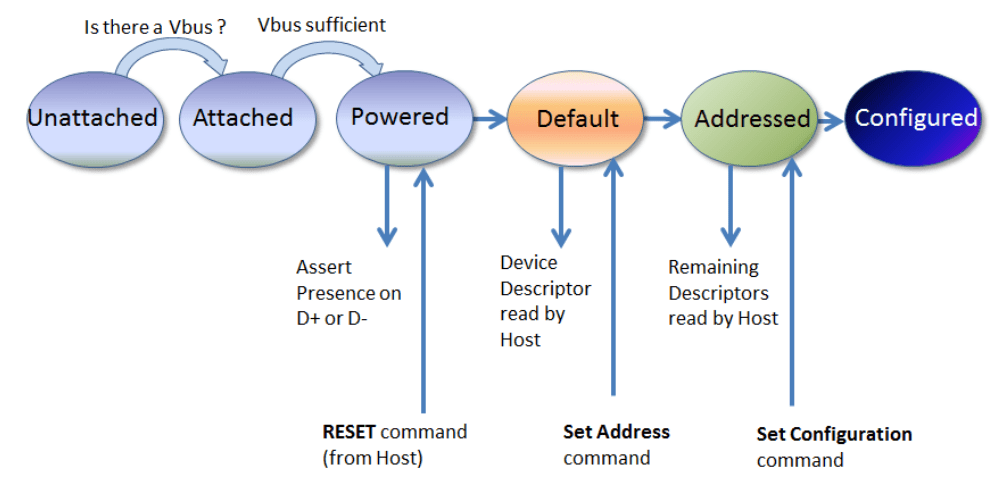
USB Enumeration Process
Device Detection
The presence of a new full-speed, high-speed, or low-speed device can be identified by changes in the D- or D+ signals. Low-speed devices place 5 V on D-, while high-speed and full-speed devices place 5 V on D+. The connection signal is detected by the hub and reported to the host. Once a device is detected, the host sends a RESET command to the device.
Default State
When the RESET control signal sequence is received, the device manages its load according to the specification for enumeration. If the connected device is a high-speed device, it returns a “chirp” to complete the high-speed detection process. Once the speed is determined, the host reads the device descriptors and assigns an address.
Address State
After the address is set, the host reads all remaining device descriptor tables. If the host determines it can service the device’s interface endpoints and provide sufficient power, it issues a command notifying the device which configurations to activate.
Configuration State
After receiving the host’s notification about which configurations to activate, the device can operate using the active configuration.





















 Ruigu Electronic
Leave a comment