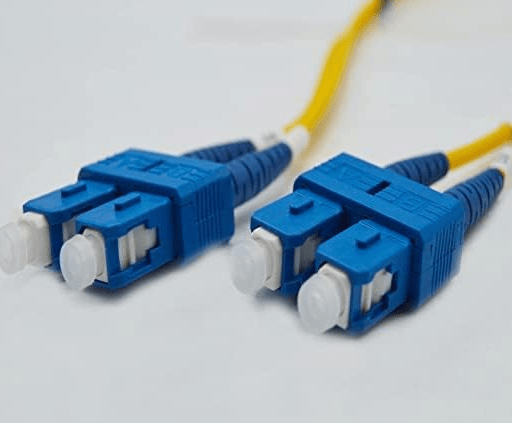
The SC (Subscriber Connector), also known as a “Square Connector” due to its rectangular shape, is a widely used fiber optic connector designed for high-performance optical communication systems. Developed by NTT (Nippon Telegraph and Telephone) in the 1980s, it has become a staple in telecommunications, data centers, and broadband networks, valued for its simplicity, reliability, and low insertion loss.
1. Design and Structure
- Core Features:
- A 2.5mm ceramic ferrule (a precision cylindrical tube) that aligns the optical fibers, ensuring efficient light transmission between connected fibers.
- A push-pull coupling mechanism: The connector features a spring-loaded tab that clicks into place when inserted into a mating adapter, providing a secure, tool-free connection.
- Square-shaped housing: The rectangular plastic or metal body distinguishes it from round connectors like ST, making it easy to identify and handle.
- Polish Types:
- PC (Physical Contact): A curved polish that minimizes air gaps between fibers, reducing insertion loss (typically ≤0.3 dB).
- UPC (Ultra Physical Contact): A more refined polish with even lower insertion loss (≤0.2 dB) and higher return loss (≥50 dB), suitable for high-speed networks.
- APC (Angled Physical Contact): An angled (8°) polish that reduces back reflection (return loss ≥60 dB), ideal for analog or high-power systems (e.g., CATV).
2. Function and Performance
- Optical Alignment: The 2.5mm ferrule ensures precise centering of fiber cores, critical for minimizing insertion loss (signal attenuation at the connection) and return loss (reflected light that disrupts signal integrity).
- Key Specifications:
- Insertion loss: Typically 0.1–0.3 dB for UPC-polished SC connectors.
- Return loss: ≥50 dB (UPC) or ≥60 dB (APC), ensuring minimal signal reflection.
- Operating temperature: -40°C to 85°C, making it suitable for indoor and outdoor environments.
3. Applications
- Telecommunications: Used in fiber-to-the-home (FTTH) networks, backbone links, and optical distribution frames (ODFs) for connecting fiber cables.
- Data Centers: Deployed in high-density environments for server-to-switch connections, leveraging its push-pull design for quick installation.
- CATV and Broadband: APC-polished SC connectors are preferred for analog video signals (e.g., cable TV) due to their low back reflection.
- Industrial Networks: Resistant to vibration and dust, making it suitable for factory automation and outdoor fiber links.
4. Advantages and Limitations
- Advantages:
- Easy Installation: Push-pull mechanism allows tool-free, one-handed operation, speeding up deployment and maintenance.
- High Reliability: Secure locking tab prevents accidental disconnection, ensuring stable performance in high-vibration environments.
- Cost-Effective: Lower manufacturing costs compared to smaller connectors like LC, making it ideal for large-scale deployments.
- Versatility: Compatible with both single-mode fiber (SMF) and multimode fiber (MMF), with color-coded housings (e.g., blue for SMF, orange for MMF) for easy identification.
- Limitations:
- Size: The 2.5mm ferrule is larger than LC’s 1.25mm ferrule, limiting port density in ultra-high-density equipment (e.g., 400G switches).
- Space Constraints: Bulkier than LC, requiring more space in patch panels and device ports.
5. Comparison to Other Fiber Connectors
| Connector | Ferrule Size | Coupling Mechanism | Port Density | Best For |
|---|---|---|---|---|
| SC | 2.5mm | Push-pull | Medium | FTTH, CATV, industrial networks |
| LC | 1.25mm | Push-pull | High | Data centers, high-density setups |
| ST | 2.5mm | Bayonet twist-lock | Low | Legacy systems, industrial links |
6. Legacy and Current Use
While LC connectors dominate high-density data centers, SC remains prevalent in telecommunications, FTTH, and industrial applications due to its reliability and cost-effectiveness. Its push-pull design and compatibility with both fiber types ensure it continues to play a key role in global fiber optic infrastructure.
In summary, the SC connector balances performance, ease of use, and affordability, making it a versatile choice for diverse optical communication needs. Its enduring popularity reflects its adaptability to evolving network technologies, from early broadband to modern fiber-to-the-premises (FTTP) deployments.





















 Ruigu Electronic
Leave a comment