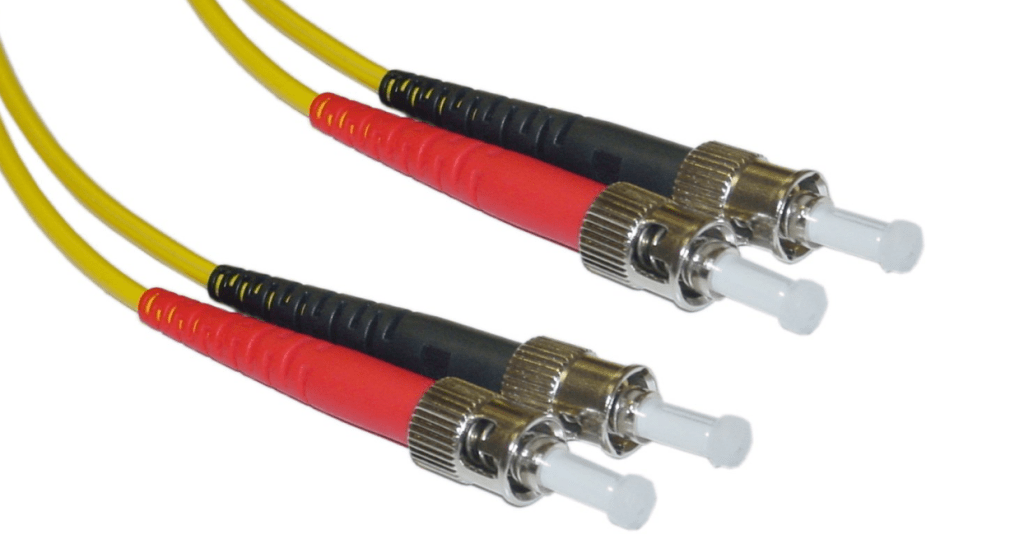
ST (Straight Tip) is a widely used fiber optic connector designed for secure, reliable connections in optical communication systems. Introduced by AT&T Bell Labs in the 1980s, it became a standard in telecommunications, data centers, and industrial networks, though it has since been partially replaced by smaller, more modern connectors like LC or SC.
1. Design and Structure
- Core Features:
- A 2.5mm ferrule (a cylindrical ceramic or metal tube) that holds the optical fiber, ensuring precise alignment between the cores of connected fibers.
- A bayonet-style coupling mechanism: The connector has a metal collar with notches that twist-lock into a mating adapter, creating a secure, vibration-resistant connection.
- Straight tip: As the name suggests, the ferrule ends in a flat, polished surface (typically “PC” or “UPC” polish) to minimize light loss at the connection point.
- Physical Appearance:
- The connector body is often made of plastic or metal, with a color-coded boot (e.g., blue for single-mode fiber, orange for multimode fiber) to indicate fiber type.
- The bayonet collar is usually metal, providing durability for repeated connections.
2. Function and Performance
- Optical Alignment: The 2.5mm ferrule ensures the fiber cores are centered and aligned, critical for minimizing insertion loss (signal loss when light passes through the connection) and return loss (reflected light that disrupts the signal).
- Loss Specifications:
- Insertion loss is typically ≤0.5 dB for well-polished ST connectors, making them suitable for most mid-range optical links.
- Return loss is ≥40 dB for UPC (Ultra Physical Contact) polished connectors, reducing signal reflection.
- Applications:
- Legacy telecommunications networks (e.g., telephone lines, fiber-to-the-node systems).
- Industrial Ethernet and factory automation, where ruggedness is prioritized.
- CCTV systems and analog fiber links, where reliable, low-cost connections are needed.
- Multimode fiber (MMF) networks, though it is also compatible with single-mode fiber (SMF).
3. Advantages and Limitations
- Advantages:
- Ruggedness: The bayonet lock resists accidental disconnection, making it ideal for harsh environments (e.g., industrial settings with vibration).
- Cost-Effectiveness: Lower manufacturing costs compared to precision connectors like LC, making it suitable for budget-conscious setups.
- Proven Reliability: Decades of use in critical systems have validated its performance in long-haul and short-haul optical links.
- Limitations:
- Size: The 2.5mm ferrule is larger than newer connectors (e.g., LC uses a 1.25mm ferrule), limiting port density in high-density equipment (e.g., data center switches with hundreds of ports).
- Installation Speed: Twisting the bayonet collar takes longer to connect than push-pull connectors like SC or LC, slowing down deployment in large networks.
- Obsolescence in High-Density Setups: Replaced by smaller connectors in modern data centers, where space efficiency is critical.
4. Comparison to Other Fiber Connectors
| Connector | Ferrule Size | Coupling Mechanism | Typical Use Case | Port Density |
|---|---|---|---|---|
| ST | 2.5mm | Bayonet twist-lock | Industrial networks, legacy systems | Low |
| SC | 2.5mm | Push-pull | Telecommunications, CATV | Medium |
| LC | 1.25mm | Push-pull | Data centers, high-density setups | High |
5. Legacy and Current Use
While ST connectors are less common in new high-speed networks (e.g., 40G/100G data centers), they remain in use in:
- Older infrastructure that hasn’t been upgraded.
- Applications where ruggedness outweighs size constraints (e.g., outdoor fiber links, mining or oilfield networks).
- Retrofit projects maintaining compatibility with existing ST-based systems.
In summary, ST connectors were a foundational innovation in fiber optics, offering a balance of reliability and cost for decades. Though surpassed by smaller, faster connectors in modern networks, their design principles (precise ferrule alignment, secure locking) influenced subsequent fiber optic connector standards.





















 Ruigu Electronic
Leave a comment