
HPD: Hot Plug Detection, abbreviated as HPD. The function of pin 19 on the standard HDMI interface is Hot Plug Detection (HPD). This signal serves as the basis for the HDMI transmitter to determine whether an HDMI display device is connected for signal transmission.
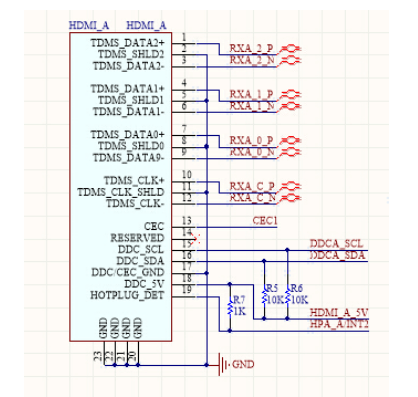
The figure above shows the interface circuit of an HDMI display. When the display is connected to the host, the host supplies power to pin 18 of the display—HDMI_A_5V—at which point this pin has a 5V voltage. HPA_A/INT2 must be discussed in two scenarios:
- The display is turned on; At this point, VCC_3V3 has a voltage, meaning Q3 is conducting and Q2 is cutoff. Since HPA_A/INT2 is pulled up to 5V via a 1k resistor, this pin is at a high level.
- The display is off; At this point, VCC_3V3 has no voltage, meaning Q3 is cutoff and Q2 is conducting. HPA_A/INT2 is grounded, so HPA_A/INT2 is at a low level.
When the host detects that HPA_A/INT2 is at a high level, the host reads the EDID data (Extended Display Identification Data) from the display’s memory via the DDC (DDC I2C bus) data channel. If the host detects that the display’s operating mode range is compatible with the graphics card, the host system can activate the graphics card’s TMDS signal transmission circuit (digital video signal transmission circuit).
Translated with DeepL.com (free version)





















 Ruigu Electronic
Leave a comment