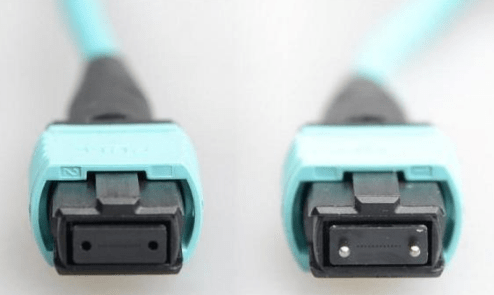
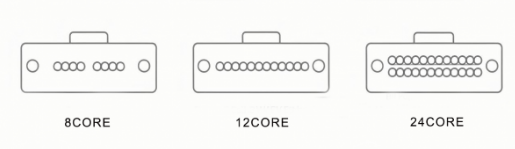
Unlike conventional LC/SC/FC fibers, MPO/MTP fibers differ significantly in the number of fiber cores they contain. MPO/MTP connector assemblies can accommodate 6 to 144 fibers, with 12-core and 24-core configurations being the most commonly used in the market today. According to specifications, 12-core MPO/MTP fiber is arranged in a single row, while 24-core or higher configurations use multiple rows. These are generally used for connection and transmission in 40G or 100G optical modules.
MPO/MTP fiber connectors come in two types: male and female. Male connectors have two pins, while female connectors do not have pins. When connecting MPO/MTP fiber optic connectors to optical modules, precise alignment is achieved via the pins. The two connectors being connected must be one male and one female.
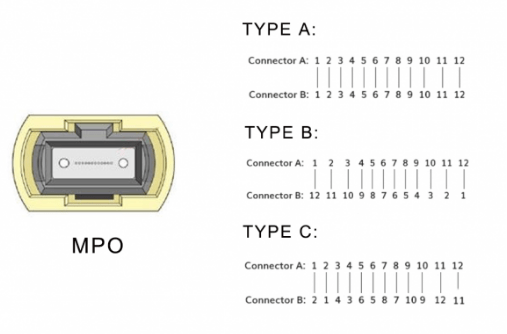
MPO/MTP connectors are classified into three types based on the arrangement of the fiber cores: Type A straight-through type; Type B interleaved type; Type C paired interleaved type.
MPO/MTP fiber can support both single-mode and multi-mode fiber, but the specific mode depends on the application and the distance the signal needs to be transmitted.
Single-mode MPO/MTP fiber is specifically designed for long-distance transmission, using a single strand of glass fiber to transmit a single beam of light. The data transmission distance for single-mode MPO/MTP fiber can reach up to 100 kilometers.
Multimode MPO/MTP fiber is designed for short-distance data transmission. It uses multiple paths (modes) to transmit light, enabling it to carry higher data rates than single-mode fiber. However, this also means that the signal weakens as the distance increases. Multimode MTP/MPO fiber is typically used for short-distance data transmission, such as within a single building or data center.





















 Ruigu Electronic
Leave a comment