In the telecommunications industry, passive optical network (PON) technology has always been at the core of fiber-optic access networks. As bandwidth demands continue to grow, PON technology has also evolved, from the initial EPON and GPON to today’s 10G EPON and 50G PON. Each technological upgrade has been accompanied by optimizations and adjustments in wavelength selection. This article will delve into the considerations and evolution of wavelength selection in PON systems, particularly the lessons learned from EPON wavelength selection and their implications for the future.The Original Intent and Limitations of EPON Wavelength Selection
EPON (Ethernet Passive Optical Network) technology was developed relatively early, with its international standards finalized in 2004. At that time, PON technology was still in its infancy, and EPON’s design specifically emphasized the cost advantages of the point-to-multipoint (P2MP) architecture. To meet this requirement, EPON prioritized the use of low-cost FP (Fabry-Perot) lasers in wavelength selection.
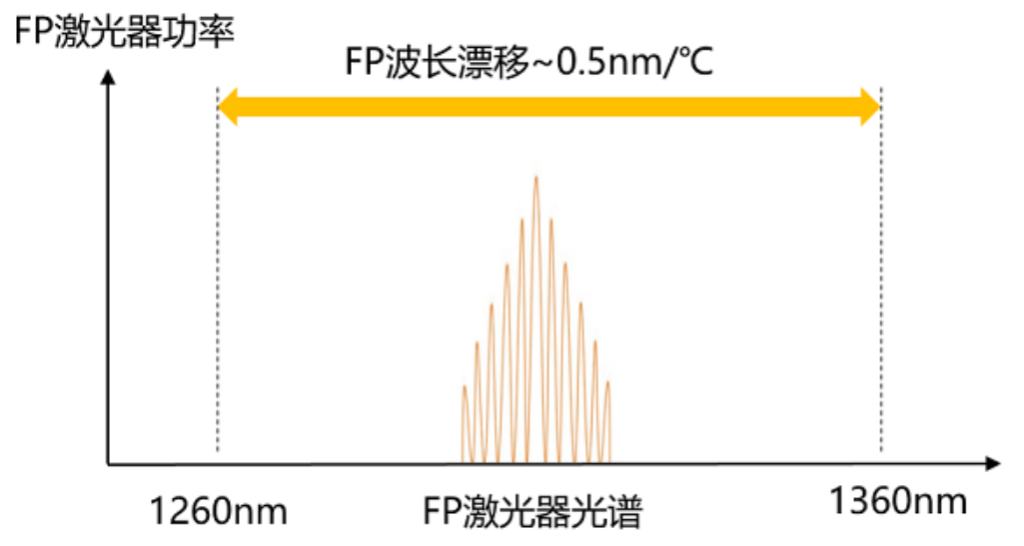
FP lasers offer the advantage of low cost, but their characteristics of multiple longitudinal modes and wavelength drift necessitate the use of a wide spectrum resource. As a result, the upstream wavelength range for EPON spans from 1260 nm to 1360 nm, with a wavelength span of up to 100 nm.
From the perspective of fiber characteristics, this wavelength range occupies all low-dispersion windows between the fiber cutoff frequency and the water peak. Although this design met the low-cost requirements at the time, it also laid the groundwork for potential issues in subsequent technological evolution. EPON’s lack of consideration for long-term evolution in wavelength selection resulted in numerous limitations. Therefore, during the early stages of PON technology development, most operators preferred to deploy GPON networks. Although GPON’s initial estimated costs were higher, with large-scale deployment and the rapid development of optoelectronic technology, GPON’s costs quickly aligned with EPON’s, while also providing operators with the added benefits of high-quality networks and the convenience of long-term evolution.
Wavelength Constraints and Solutions in the 10G EPON Phase
As the need for generational evolution in PON technology became increasingly evident, the rapid development and cost reduction of DFB (Distributed Feedback) laser technology sparked industry attention on EPON wavelength constraints. The industry began considering revisions to EPON standards and wavelength specifications. During the initial phase of 10G-EPON large-scale deployment in 2017, operators narrowed the EPON upstream wavelength range from the broad 1260nm–1360nm band to the narrower 1290nm–1330nm band through the establishment of enterprise standards.
However, during the 10G EPON phase, wavelength constraints became a bottleneck for technological evolution. Since the standard definition could not avoid the wavelength range of existing FP lasers to independently select the upstream wavelength (the downstream wavelength selected the 1577nm wavelength with higher dispersion), the industry ultimately addressed the wavelength constraints through collaborative innovation by adopting an upstream time-division scheme. This scheme sacrificed uplink efficiency and made certain performance compromises but enabled smooth network deployment. Meanwhile, operators began deploying narrowband EPON terminals, naturally phasing out wideband FP EPON terminals through deployment cycles, thereby clearing obstacles for future PON network upgrades.
Wavelength Selection and Normalized Evolution for 50G PON
With the advent of 50G PON technology, the wavelength issue for EPON FP has once again drawn attention. The 50G-rate wavelength needs to be deployed in the low-dispersion region, but due to the significant increase in dispersion within the 1360–1490 nm range and the constraints imposed by the fiber water peak on existing network deployments, and considering that the EPON narrowband standard has been in use for many years, the industry reached a consensus after careful consideration during the definition of international standards. From the perspectives of technical requirements and industrial development, only EPON narrowband coexistence was considered. The 50G PON standard has standardized the coexistence evolution of EPON/GPON, marking an important milestone in the evolution of the PON industry.
The wavelength selection for 50G PON not only considers technical specifications but also fully takes into account the actual deployment conditions of existing networks. Through narrowband coexistence, 50G PON achieves a smooth transition with existing EPON/GPON networks from a technical perspective, providing operators with greater flexibility and scalability. This evolution process fully demonstrates the industry’s maturity and wisdom in wavelength selection.
Lessons Learned and Future Outlook
The historical experience with EPON wavelengths teaches us that we should not blindly pursue short-term cost savings. Instead, we should trust in the rapid development of technology and demand, and consider the long-term evolution of the network. With the commercial deployment of 50G PON now underway, the current focus for EPON should be on identifying and addressing FP wavelength issues in existing networks, preparing for the deployment of 50G PON in existing networks, and enhancing network competitiveness.
In the future, as PON technology continues to evolve, wavelength selection will remain a critical factor. The industry must strike a balance between technological innovation and cost control to ensure the long-term evolution and sustainable development of networks. Meanwhile, operators should actively participate in standard-setting to drive collaborative innovation across the supply chain and collectively address the challenges and opportunities presented by next-generation PON technology.





















 Ruigu Electronic
Leave a comment